
The 4 Pillars of Running Success
Most runners aren’t getting injured by accident; we get injured because we have the wrong priorities and are searching for shortcuts to our goals. We often try to supplement with the latest and greatest: buying new shoes, adding compression socks, foam rolling more often, grabbing a TheraGun, and hoping this will be enough to pull through our goal race build.
Then…when the wheels start to come off, we assume it’s bad luck. But the reality is this:
You didn’t get injured on purpose, but it was preventable.
Not because you’re fragile, and not because your body “can’t handle running,” but because the foundation wasn’t built the right way.
I see this often in the clinic: runners who are motivated, consistent, and doing what they think is right, yet they’re stuck in the cycle of progress, pain, time off, and starting over. The runners who stay healthy, improve, and actually run their best don’t rely on hacks or quick fixes. They build capacity, train with intent, and focus on what actually moves the needle.
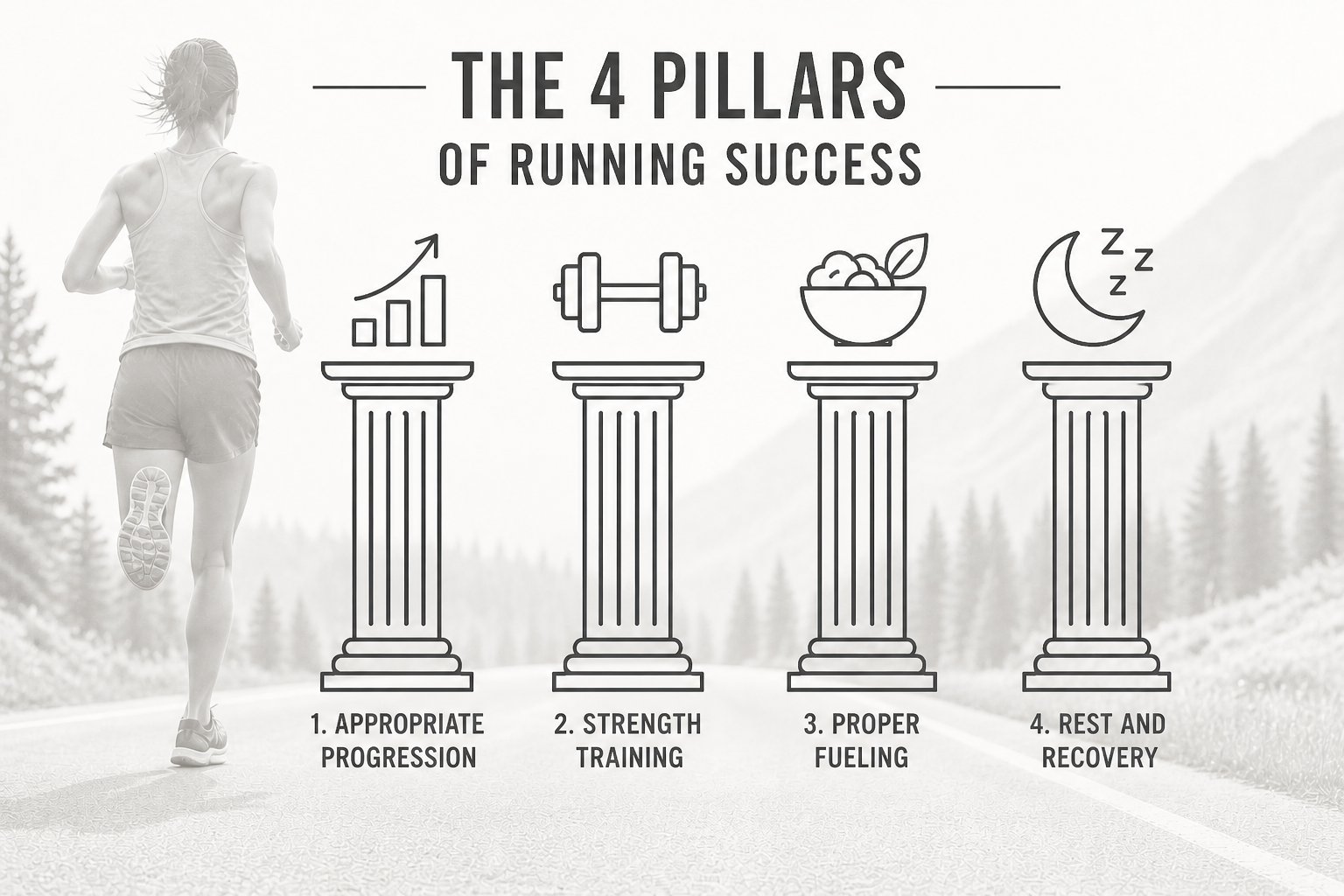
If you want to stay consistent, prevent injury, and take your running to the next level, everything comes back to Four Key Pillars: (1) Appropriate running progression, (2) Strength training that supports your running, (3) Proper fueling, and (4) Sleep, rest, and recovery. Miss one, and you leave the door open for setbacks. Dial them in, and everything changes.
Pillar 1: Appropriate Running Progression
If there’s one place most runners get it wrong, it’s here. Not because we don’t care or aren’t working hard, but because we are trying to do too much, too soon, and our bodies simply aren’t ready for it yet.
This is the number one reason for running injury…by far!
Depending on your experience and training history, our fitness can improve somewhat quickly, but it’s our motivation as runners that can spike to dangerous levels. When this happens, our ‘running spirit’ carries us to areas where our tendons, bones, and connective tissue are not yet ready to be.
When training progresses faster than our body can adapt, something eventually breaks down. This is where most running injuries actually come from, not bad shoes or poor form, but load that exceeds your current capacity.
When I consult with and work with runners, we return to the same principles over and over: build capacity, respect the load, and start where you are while gradually progressing toward where you want to be. The problem is that many runners, unintentionally (sometimes intentionally, as we are often an impatient bunch), violate these principles. They increase mileage too quickly, add intensity while increasing volume, and follow their plan at all costs, even when their body is giving clear warning signs to pull back.
Research has consistently shown that rapid increases in training load, specifically spikes in weekly mileage and long run distance, are associated with higher injury risk, particularly when increases exceed the body's current ability. I would advise paying close attention to the weekly long run, as it requires one of the week's highest mechanical loads on the body. When that stress increases too quickly, tissues don’t have enough time to adapt, and the risk of overload rises. This is why progression needs to be intentional, not aggressive.
Another key shift runners need to make is understanding that progression is not linear. You can’t simply add mileage every week and expect to stay healthy. Your body needs time to absorb the work you’re doing, which is where deload or cutback weeks become essential. Every 4-6 weeks, a planned reduction in volume allows your body extra time to recover, adapt, and grow. Without these built-in resets, training becomes a constant accumulation of fatigue rather than a process of adaptation.
Pain also plays an important role in this process, and it’s often misunderstood. Many runners treat pain as something to ignore or push through, but it’s better viewed as feedback. A tight calf, a sore Achilles, or knee pain from Runner’s Knee or IT Band Syndrome that shows up consistently during a run is your body signaling that something needs to change. Adjusting early, whether that’s reducing volume, modifying intensity, or improving recovery (likely, all 3 are necessary), keeps you in control. Ignoring those signals often leads to bigger problems that force you to alter your plan or even end up on the DNS list.
Ultimately, our goal of appropriate progression as runners is simple: consistent, uninterrupted training. The runners who improve the most aren’t the ones who have perfect individual weeks or push the limits like the pros, but the ones who can stack weeks, months, and even years of training together without setbacks. That’s where real running performance gains happen.
Progressing your training the right way isn’t about holding you back; it’s about giving you the best opportunity to move forward. When you build capacity, respect the load, and progress with intent, you don’t just reduce your risk of injury; you put yourself in the best position to run your very best for years to come.
Pillar 2: Strength Training
If appropriate progression builds the foundation, strength training is what allows us to actually handle it. This is where we separate runners who are constantly dealing with aches and setbacks from those who stay healthy, remain consistent, and continue to improve. At The Runner's Fix, this is our bread and butter, and it’s one of the most misunderstood and underutilized parts of running performance.
Too often, strength training gets reduced to high-rep band and bodyweight work and random gym routines. Distance running is a high-stress, repetitive activity, and if we want to handle the involved load, we need to actually get stronger! This means using enough resistance to challenge our body, not just going through the motions. Research consistently shows that strength training improves running economy, reduces injury risk, and enhances performance without negatively affecting endurance. When done right, we’re not getting bulky (more on that belief another time), we’re becoming more efficient, more resilient runners.
The biggest issue we see isn’t that runners are doing too much strength work; it’s that they’re not doing enough of the right kind. We avoid heavy loads, stick to high reps, or follow “gym-bro” splits that don’t match the demands of running or align with our goals. Instead, we should aim for a simple, structured approach: 2-3 full-body sessions per week, focusing on key movements like single-leg work, hinging, squatting, calf strength, and core stability. Loads should be challenging, typically in lower rep ranges, leaving a few reps in reserve so we build strength without excessive fatigue.
Where we place our strength work matters just as much as the exercises we do. For most, I recommend keeping your hard days hard and easy days easy, which means lifting the same days as your harder runs so that your easy days stay easy and you ALWAYS protect your rest day. Time doesn’t have to be a barrier either. A focused 20-25 minute session can be incredibly effective, and with consistency, soreness becomes less of an issue as the body adapts.
Ultimately, strength training is one of the most powerful tools we have to support our running. Stronger runners are healthier, faster, and more resilient. They handle higher training loads, stay more consistent, and have the strength to push when it matters. If we want to run our best and prevent injury, strength training isn’t optional; it’s essential, and it’s exactly what we build into our ST4R: Run Strong Program.
Pillar 3: Proper Fueling
If we’re training hard but not fueling properly, we’re leaving performance on the table and increasing our risk of injury. Fueling is one of the most overlooked aspects of running, yet it directly affects how we perform, recover, and adapt to training. We have to treat fueling as part of the training process. If we want to run our best and stay healthy, we have to fuel with intent.
One of the most common mistakes we see is underfueling, especially around runs. Morning runs done completely fasted, skipping post-run nutrition, or holding back on carbohydrates are all habits that limit performance and delay recovery. Running is a carbohydrate-driven activity, and if we don’t provide the body with enough fuel, we’re asking it to perform and recover without the resources it needs.
Protein also plays a key role, particularly in recovery and tissue repair, yet many runners simply aren’t getting enough to support their training. Current sports nutrition guidelines, including those from the National Strength and Conditioning Association, suggest that endurance athletes typically benefit from about 1.4–1.8 g/kg/day of protein, with some recommendations slightly higher depending on training load. When we don’t meet these needs, we limit our ability to recover, adapt, and build the capacity we’re working toward.
From a practical standpoint, every run should be fueled. That starts with eating before we run, even if it’s something small and easy to tolerate. For longer runs, typically those lasting more than 60 minutes, adding carbohydrates during the run helps maintain energy and reduce overall stress on the body. Current sports nutrition guidelines generally recommend 30-60 grams of carbohydrates per hour for endurance exercise, with higher amounts (up to ~90 g/hr) for longer or more demanding efforts when tolerated. After the run, our recovery begins with fueling, providing carbohydrates and protein to replenish energy stores and support repair.
There’s also a broader consideration here. Consistently underfueling relative to training demands can lead to low energy availability, which has been linked to increased injury risk, impaired recovery, and reduced performance. This is where working with a running-specific dietitian can be especially valuable. If fueling is restricted by need or choice, or if injuries recur despite appropriate training progression, having a professional guide nutrition strategies can help support both performance and long-term health.
Ultimately, fueling should be planned and practiced like any other part of training. When we consistently fuel our runs, support recovery, and match our intake to our workload, we give our body the best chance to adapt, stay healthy, and keep progressing.
Pillar 4: Sleep, Rest, and Recovery
The improvement we seek as runners doesn’t come from training; it comes from the recovery process after training. Every run, every lift, every workout is simply a stress placed on the body. The adaptations we’re after, the stronger tissues, improved endurance, better performance, only happen when we give the body time and resources to recover. If we ignore this side of the equation, progress will stall and injury risk will climb.
It’s simple: make time for rest and recovery now, or be forced to take it later because of an injury.
Sleep is the foundation of recovery. Most runners should aim for 8–9 hours of sleep per night, and no less than 7 consistently. Just as important as total hours is consistency; going to bed and waking up at similar times helps regulate recovery, hormone balance, and overall performance. Research consistently shows that inadequate sleep is associated with decreased performance, impaired recovery, and increased injury risk. When sleep is off, everything else becomes harder, training quality drops, recovery slows, and small issues are more likely to become bigger problems.
Rest days are just as important, and this is where many runners struggle. We often feel like we should be doing something every day, an easy run, cross-training, or a quick lift, but a true rest day means exactly that: rest. At least one complete rest day each week, no excuses. This is where the body absorbs training, reduces accumulated fatigue, and resets for the training week ahead.
This also ties directly to progression. As we discussed in Pillar 1, training isn’t meant to increase indefinitely. Every 4–6 weeks, we should plan a deload or cutback week to give the body extra time to recover and adapt. Without these built-in breaks, fatigue continues to accumulate, and the line between productive training and overload grows thinner with each passing week.
Post-race recovery is another area that often gets overlooked. After a goal race, especially longer events like a half-marathon or marathon, the body needs a solid reset. That typically means 10–14 days of complete rest from structured training, focusing only on activities of daily living, light walking, and gentle mobility. Jumping back into running too quickly after a race is one of the fastest ways to turn a successful build into the start of an injury cycle.
When we look at the common mistakes runners make, they’re all connected. Skipping rest days, always doing something, treating easy days as a substitute for recovery, and avoiding downtime after races all add up. Over time, this creates a constant state of fatigue in which the body never fully adapts. Training becomes something we survive rather than something we improve through.
Ultimately, recovery is what enables everything else to work. Proper progression builds the plan, strength training builds capacity, and fueling supports the process, but sleep, rest, and recovery are what make the entire system effective. When we prioritize recovery, we train better, adapt more consistently, and stay healthy long enough to see the results we’re working toward.
Running more isn’t the answer; training smarter is. When we bring these four pillars together, appropriate progression, strength training, proper fueling, and intentional recovery, we give ourselves the best chance to stay consistent, avoid injury, and actually improve. Miss one, and progress becomes harder. Dial them in, and everything starts to click. If we want to run our best, it’s not about doing more; it’s about doing the right things consistently over time.
References:
Damsted, C., Glad, S., Nielsen, R. O., & Sørensen, H. (2018). Is there evidence for an association between changes in running training load and running-related injuries? A systematic review. International Journal of Sports Physical Therapy. https://ijspt.scholasticahq.com/article/18861
Gabbett, T. J. (2016). The training—injury prevention paradox: Should athletes be training smarter and harder? British Journal of Sports Medicine. https://bjsm.bmj.com/content/50/5/273
Hulin, B. T., Gabbett, T. J., Blanch, P., Chapman, P., Bailey, D., & Orchard, J. W. (2014). Spikes in acute workload are associated with increased injury risk in elite cricket fast bowlers. British Journal of Sports Medicine. https://bjsm.bmj.com/content/48/8/708
Nielsen, R. O., Parner, E. T., Nohr, E. A., & Sørensen, H. (2014). Excessive progression in weekly running distance and risk of running-related injuries: An association which varies according to type of injury. Journal of Orthopaedic & Sports Physical Therapy. https://www.jospt.org/doi/10.2519/jospt.2014.5164
Bertelsen, M. L., Hulme, A., Petersen, J., Brund, R. K., Sørensen, H., Finch, C. F., & Nielsen, R. O. (2017). A framework for the etiology of running-related injuries. Scandinavian Journal of Medicine & Science in Sports. https://onlinelibrary.wiley.com/doi/10.1111/sms.12883
Edwards, W. B. (2010). Modeling overuse injuries in sport as a mechanical fatigue phenomenon. Exercise and Sport Sciences Reviews. https://journals.lww.com/acsm-essr/Fulltext/2010/04000/Modeling_Overuse_Injuries_in_Sport_as_a_Mechanical.8.aspx
Videbæk, S., Bueno, A. M., Nielsen, R. O., & Rasmussen, S. (2015). Incidence of running-related injuries per 1000 hours of running in different types of runners: A systematic review and meta-analysis. Sports Medicine. https://link.springer.com/article/10.1007/s40279-015-0333-8
Blagrove, R. C., Howatson, G., & Hayes, P. R. (2018). Effects of strength training on the physiological determinants of middle- and long-distance running performance: A systematic review. Sports Medicine. https://link.springer.com/article/10.1007/s40279-017-0835-7
Balsalobre-Fernández, C., Santos-Concejero, J., & Grivas, G. V. (2016). Effects of strength training on running economy in highly trained runners: A systematic review with meta-analysis. Journal of Strength and Conditioning Research. https://journals.lww.com/nsca-jscr/Fulltext/2016/08000/Effects_of_Strength_Training_on_Running_Economy.31.aspx
Paavolainen, L., Häkkinen, K., Hämäläinen, I., Nummela, A., & Rusko, H. (1999). Explosive-strength training improves 5-km running time by improving running economy and muscle power. Journal of Applied Physiology. https://journals.physiology.org/doi/full/10.1152/jappl.1999.86.5.1527
Bohm, S., Mersmann, F., & Arampatzis, A. (2015). Human tendon adaptation in response to mechanical loading: A systematic review and meta-analysis. Sports Medicine.
https://link.springer.com/article/10.1007/s40279-015-0304-0Thomas, D. T., Erdman, K. A., & Burke, L. M. (2016). Position of the Academy of Nutrition and Dietetics, Dietitians of Canada, and the American College of Sports Medicine: Nutrition and athletic performance. Journal of the Academy of Nutrition and Dietetics.
https://www.jandonline.org/article/S2212-2672(15)01802-X/fulltextKerksick, C. M., Wilborn, C. D., Roberts, M. D., et al. (2018). ISSN exercise & sports nutrition review update: Research & recommendations. Journal of the International Society of Sports Nutrition.
https://jissn.biomedcentral.com/articles/10.1186/s12970-018-0242-yMountjoy, M., Sundgot-Borgen, J., Burke, L., et al. (2018). IOC consensus statement on relative energy deficiency in sport (RED-S): 2018 update. British Journal of Sports Medicine. https://bjsm.bmj.com/content/52/11/687
Watson, A. M. (2017). Sleep and athletic performance. Current Sports Medicine Reports.
https://journals.lww.com/acsm-csmr/Fulltext/2017/12000/Sleep_and_Athletic_Performance.5.aspxMilewski, M. D., Skaggs, D. L., Bishop, G. A., et al. (2014). Chronic lack of sleep is associated with increased sports injuries in adolescent athletes. Journal of Pediatric Orthopedics.
https://journals.lww.com/pedorthopaedics/Fulltext/2014/03000/Chronic_Lack_of_Sleep_is_Associated_With_Increased.1.aspxFullagar, H. H. K., Skorski, S., Duffield, R., et al. (2015). Sleep and athletic performance: The effects of sleep loss on exercise performance and physiological and cognitive responses to exercise. Sports Medicine. https://link.springer.com/article/10.1007/s40279-015-0380-7